In medium-voltage grids, too, challenges are mounting due to decentralized power sources and new types of electrical loads. Measurement technology provider PQ Plus offers solutions that enable comprehensive, continuous monitoring—while also enhancing transparency within low-voltage networks.
The growing number of PV systems on residential and commercial properties, along with the proliferation of electric vehicle charging points and heat pumps, has brought the monitoring of low-voltage grids into sharp focus. However, the transition in the energy, transport, and heating sectors is clearly also manifesting at the medium-voltage level—bringing with it potentially problematic interactions between different voltage tiers. "The rapid expansion of decentralized generation plants, the emergence of bidirectional load flows, and an increase in non-linear loads are placing growing pressure on power quality," explains Jens Schübel, authorized signatory and Technical Director at PQ Plus GmbH. Furthermore, decentralized generation units, energy storage systems, and high-power fast-charging stations—often in the range of several hundred kilowatts—frequently generate or exacerbate harmonic currents. The consequences can include the overloading of grid equipment, issues with protection systems or reactive power management, and, not least, disturbances in customers' electrical installations—for which the grid operator may ultimately be held liable.

Photo: AI-generated
Precise Monitoring
To proactively prevent grid disturbances and comprehensively document compliance with the quality standards set out in EN 50160, the monitoring of the medium-voltage level via precise measurement is becoming increasingly important. In this context, power quality analyses are focusing not only on harmonics but also on higher-frequency components and supraharmonics. "Many grid operators have recognized this challenge and are increasingly investing in monitoring at the medium-voltage level," reports Jens Schübel, drawing on his experience with numerous customer projects. He points to a key distinction compared to measurements in the low-voltage network: "For statistical evaluations, grid analyses, and general power quality assessments—typically required at the low-voltage level—Class S measurements (as defined by IEC 61000-4-30) are sufficient; these can be performed, for example, using our UMD 98 (GC) devices at the outgoing feeders of local distribution substations." In contrast, applications in the medium-voltage range—where a high degree of comparability and reproducibility of results is essential—often require Class A measurements. "Class A devices must adhere to significantly stricter accuracy limits and synchronize their measurements with UTC time. They are therefore indispensable in situations such as resolving disputes regarding contractual agreements or verifying compliance with standards," Schübel explains. PQ Plus GmbH offers a portfolio of tailored, Class A-certified solutions designed to meet these requirements.
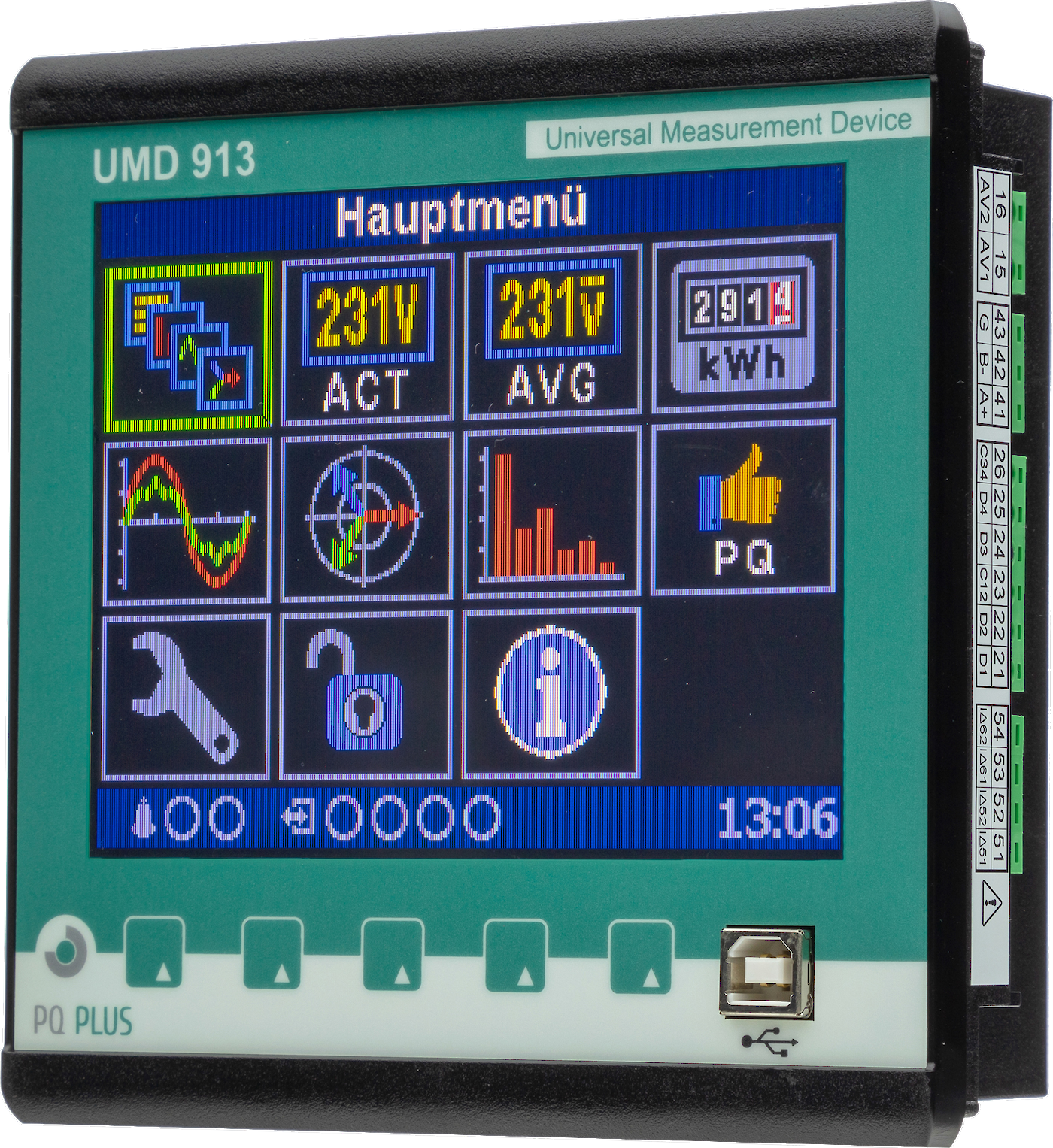
The Class A universal measuring device UMD 913 for panel mounting.
(Photo: PQ Plus GmbH)
Precision for Every Installation Scenario
The UMD 913 universal measuring device has established itself as a high-performance power quality analyzer for seamless monitoring directly at grid nodes. Designed for panel mounting, the device features high-precision, 4-phase current and voltage measurement in 4-quadrant operation. With a measurement accuracy of Class 0.05 (and Class 0.2S for energy measurement), the system detects even the most minute harmonics—up to the 128th order—as well as transient disturbances. Certified as Class A according to IEC 61000-4-30, the UMD 913 provides reliable, standards-compliant data for assessing power quality. Its integrated disturbance recorder, combined with precise time synchronization (via GPS or NTP), ensures that grid disturbances can be accurately timestamped, allowing for the definitive identification of their source. For applications where space in control cabinets or compact local substations is limited, the manufacturer recommends the UMD 710 product family. "This series also meets Class A requirements, but is designed for DIN-rail mounting—combining an ultra-compact footprint with the performance features of high-end analyzers," explains Schübel. The UMD 710MVU is specifically tailored for medium-voltage applications; it features specialized measurement inputs designed for the direct connection of modern low-signal voltage sensors (3.25 V / √3). This eliminates the need for traditional, heavy, and expensive medium-voltage transformers. Alternatively, the UMD 710EVU variant is available for CAT IV environments, capable of processing voltages directly up to 1470 VLL. Both models support a sampling rate of 28.8 kHz, capture harmonics and supraharmonics in a frequency range up to 9 kHz (180th harmonic), and include a 512 MB data logger as well as an integrated web server for rapid on-site monitoring.
Seamless Integration
For both product series, PQ Plus places a strong emphasis on connectivity. Through open interfaces—such as Ethernet, RS485, and a front-facing USB port—and protocols including Modbus TCP/IP, Modbus RTU, JSON, or SNMP, measurement data from PQ Plus devices can be seamlessly integrated into higher-level SCADA systems, ISO 50001-compliant energy management software, or smart grid infrastructures.
Comprehensive Transparency
Stadtwerke Erlangen demonstrates how comprehensive medium-voltage monitoring can be implemented in practice. The distribution grid operator relies consistently on PQ Plus for its medium-voltage measurements, having equipped its entire medium-voltage network with UMD 913 power quality analyzers. Thanks to the devices' ease of integration and compact design, it was possible to upgrade not only new installations but also older, existing substations to the required high level of monitoring—in compliance with the EN 50160 standard—without the need for costly modifications to the switchgear. In parallel, Stadtwerke Erlangen monitors the low-voltage grid using a solution from their partner company, GridCal, while also incorporating data from the medium-voltage level. "Due to new grid requirements and the energy transition, the medium-voltage network has evolved into an actively influenced system. Consequently, our customers are increasingly integrating medium-voltage measurements into their low-voltage monitoring, allowing them to assess the impact of PV systems, energy storage, charging infrastructure, and other power-electronic equipment across the entire grid," explains Jens Schübel. Combining medium- and low-voltage measurements facilitates the identification of the root causes of disturbances, the assessment of power quality, the planning of grid expansion measures, and the development of a data-driven approach to grid operation.
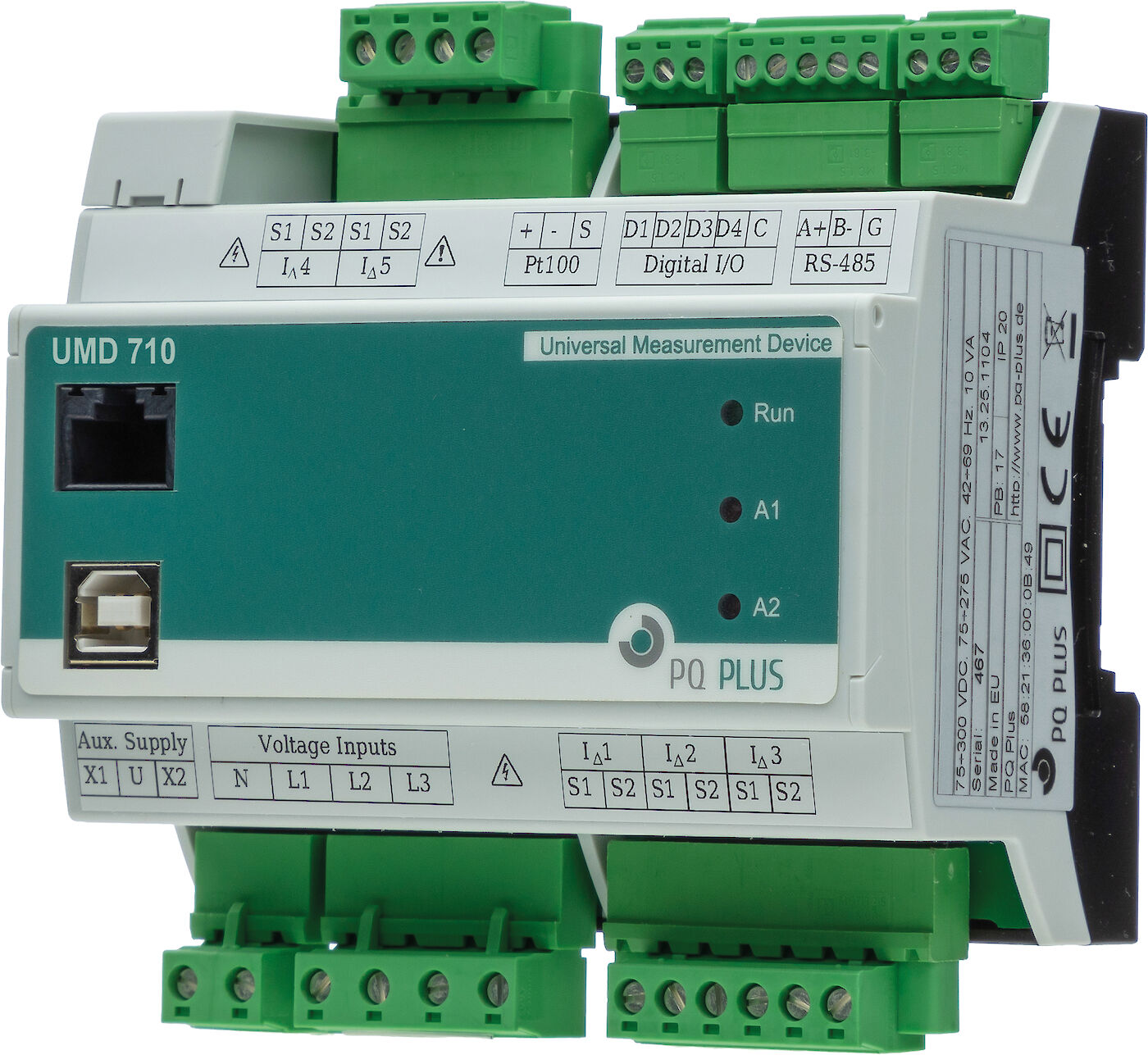
The compact UMD 710 devices are designed for DIN-rail mounting.
(Photo: PQ Plus GmbH)
